 USA
USA Mexico
 Canada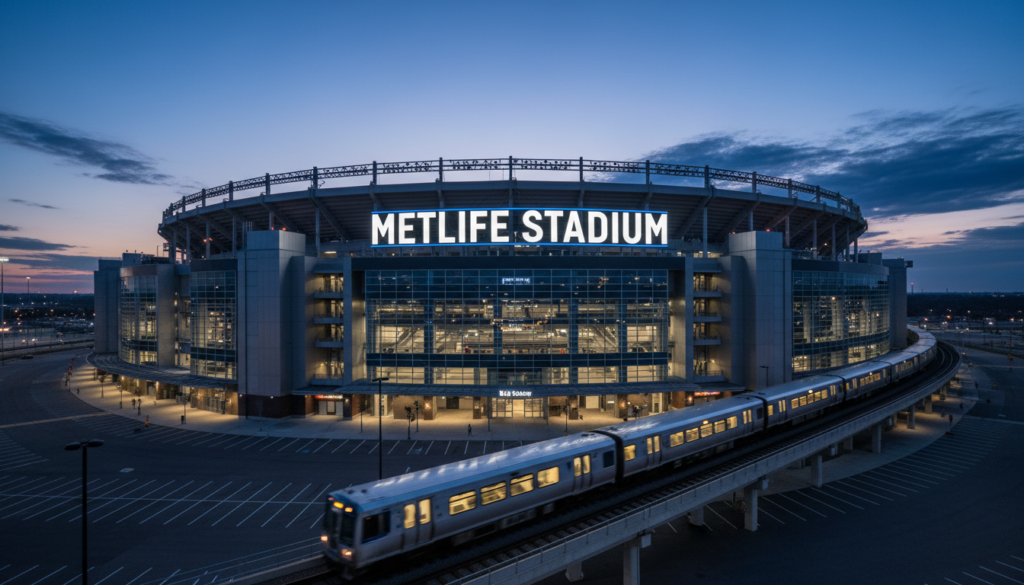
You have just stepped off a grueling transatlantic flight into the bustling, neon-lit chaos of John F. Kennedy International Airport. Your passport is stamped, your luggage is finally in your hands, and you are buzzing with adrenaline. Why? Because you hold a golden ticket to the 2026 North American Summer Tournament. You are about to witness the pinnacle of the international football championship, surrounded by tens of thousands of screaming fans. But right now, standing on the curb in Queens, a sudden realization hits you like a cold New York winter wind: MetLife Stadium is in an entirely different state.
Welcome to the ultimate logistical marathon. New York City and New Jersey might look like neighbors on a map, but separating your airport terminal from your stadium seat is a sprawling metropolis, a massive river, and some of the most notorious traffic bottlenecks on the planet. As an international fan, you are probably wondering how to bridge this gap without emptying your wallet before you even buy your first overpriced stadium hot dog.
You see, getting to major North American football venues requires a game plan. If you go in blind, the city will happily chew up your travel budget. But do not worry, my friend. We have mapped out the exact transit playbook you need. Let’s dive into the absolute cheapest, most efficient way to conquer this concrete jungle.
Why You Should Avoid Taxis and Rideshares
Let me guess. Your first instinct, fueled by jet lag and excitement, is to pull out your phone, open Uber or Lyft, and type in “MetLife Stadium.” Stop right there. Put the phone back in your pocket.
Taking a taxi or rideshare from JFK to East Rutherford on a match day is the financial equivalent of leaving a faucet running while you are on vacation. Sure, slipping into the back of a black SUV feels convenient, but the reality is far from a luxury experience. You are not buying speed; you are buying a very expensive front-row seat to the Brooklyn-Queens Expressway parking lot.
On a standard day, this ride will easily cost you $100 to $130. But on the day of a massive international football championship match? Surge pricing will rear its ugly head, and you could be staring at a staggering $150 to $200+ fare. Think about what else you could do with that money. That is the cost of a new team jersey, a round of drinks for your friends, or a decent chunk of your hotel bill.
Furthermore, you have to cross the Hudson River. That means navigating the Lincoln Tunnel or the George Washington Bridge alongside thousands of other fans, commuters, and delivery trucks. It is a slow-moving sea of red taillights. Do you really want to spend two hours of your life trapped in the back of a cab, anxiously checking your watch as kickoff approaches? Skip the rubber tires and embrace the steel rails.
The Budget Champion: The Three-Step Train Strategy
If you want to travel like a true, street-smart New Yorker, you have to go underground. The absolute cheapest way to get from JFK to the stadium is what I like to call the “Three-Step Train Strategy.” It involves the AirTrain, the New York City Subway, and New Jersey Transit.
Is it going to require some walking? Yes. Will you have to navigate a few crowded platforms? Absolutely. But this entire journey will cost you roughly $16 in total. When you compare $16 to $150, the choice becomes a no-brainer. Let us break down this budget-saving crusade step by step.
Step One: Escaping JFK Airport via the AirTrain
Your journey begins the moment you clear customs. Look up, and follow the bright green signs pointing toward the “AirTrain.” JFK is a massive, sprawling complex, but the AirTrain is the great equalizer, a driverless people-mover that connects all the terminals to the outside world.
Here is the crucial part: there are different AirTrain lines. You do not want to ride in circles around the airport forever. You need to board the train heading to Jamaica Station. Do not get on the train heading to Howard Beach. Jamaica is your gateway to Manhattan.
The AirTrain itself is a smooth, elevated ride that gives you your first real glimpse of the Queens skyline. You do not pay when you get on the AirTrain at the terminal; you pay when you get off at Jamaica Station. As of recent 2026 updates, the standard fare is $8.50. However, the Port Authority sometimes implements summer discounts to ease traffic, occasionally dropping the fare to $4.25 between June and Labor Day, so keep an eye out for that beautiful half-price surprise!
When you hit the turnstiles at Jamaica, you don’t even need to fumble for a physical ticket. New York runs on the OMNY system now. Just tap your contactless credit card, debit card, or your smartphone with Apple/Google Pay directly on the glowing screen at the gate. It is fast, seamless, and perfectly suited for international travelers who haven’t had a chance to get local currency yet.
Step Two: Riding the Rails into Manhattan
Once you tap through the gates at Jamaica Station, you will feel the undeniable pulse of the city. You are now at a major transit hub, and you have a choice to make. You can either take the Long Island Rail Road (LIRR) or the New York City Subway.
If you are a strict budget warrior, you want the subway. Specifically, you want the E Train (the blue line on the map) heading toward Manhattan. The subway fare recently bumped up to a flat $3.00 in 2026, but it remains one of the greatest transportation bargains in the world. Again, tap your phone or contactless card at the OMNY reader.
The E train is a classic New York experience. It is loud, wonderfully diverse, and authentically gritty. Grab a seat, secure your bags between your legs, and settle in for about a 40 to 45-minute ride. You will rumble beneath the boroughs, shooting through Queens and under the East River until you reach the belly of the beast: Manhattan. Your destination is 34th Street–Penn Station.
Pro Tip: If you are willing to spend just a few dollars more for speed and comfort, take the LIRR from Jamaica to Penn Station instead of the subway. Using the “CityTicket” option during off-peak hours costs around $5.00 to $7.00, and it cuts the travel time down to a breezy 20 minutes. But if every penny counts, the $3.00 E train is your trusty steed.
Step Three: The NJ Transit Leap to East Rutherford
You have made it to Penn Station! Take a deep breath. Penn Station is notoriously chaotic, a subterranean labyrinth of food stands, hurrying commuters, and confusing digital departure boards. But do not panic. Your goal is simple: find the concourse for NJ Transit.
Look for the orange and blue NJ Transit ticket vending machines, or even better, avoid the lines entirely by downloading the NJ Transit mobile app. At the same time, you ride the subway (assuming you grabbed an eSIM from our recommended travel marketplace to stay connected offline!).
You need to buy a ticket to the Meadowlands Sports Complex. The cost is right around $4.50. On major match days for the 2026 North American Summer Tournament, NJ Transit activates a special event rail service. Here is how the final leg works:
First, you will board any NJ Transit train stopping at Secaucus Junction. This is a massive transfer hub, just one stop (about 10 minutes) away from Penn Station. When you arrive at Secaucus, get off the train. You will immediately notice a massive sea of fans wearing face paint, waving flags, and chanting team songs. Follow that crowd. They are all heading downstairs to the Meadowlands Rail Line.
You board this special shuttle train, and in about 15 short minutes, you will pull out of the swamplands and arrive right at the doorstep of MetLife Stadium. You step off the train, the massive metal architecture of the arena looms overhead, and you have officially completed the journey. You did it. And you did it for less than the cost of a stadium beer.
Alternative Bus Routes: The Port Authority Playbook
Now, what if trains aren’t your style, or you are making a pit stop in Times Square before heading to the game? There is another highly viable budget option that avoids the deep underground: the bus.
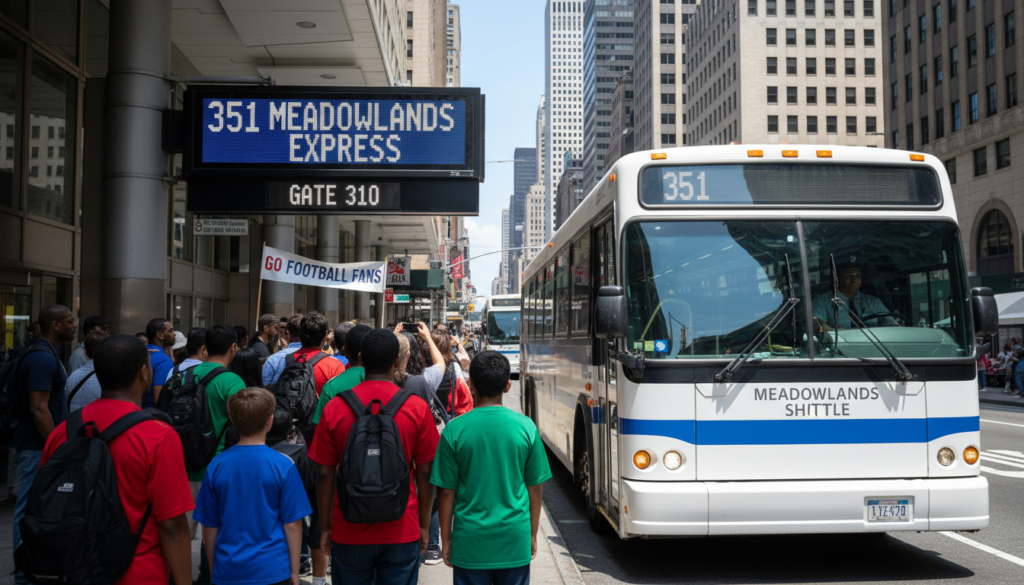
If you are staying in midtown Manhattan, you can head to the Port Authority Bus Terminal (PABT) located at 42nd Street and 8th Avenue. On event days, Coach USA operates the 351 Meadowlands Express bus.
You purchase your ticket at the terminal (usually around $14 round trip, though prices fluctuate slightly for special events). You line up at the designated gate, board a comfortable, air-conditioned coach, and let a professional driver navigate the Lincoln Tunnel for you.
Is it as cheap as the subway-to-train combo? Almost. Is it faster? That depends entirely on traffic. The bus is fantastic if you manage to leave Manhattan several hours before kickoff. But if you try to catch the bus 90 minutes before the game starts, you will find yourself staring out the window at gridlocked cars, praying to the traffic gods for mercy. Our advice? Use the bus if you are traveling very early, but rely on the rails when time is of the essence.
Insider Tips for International Football Fans
Traveling across borders for a massive sporting event comes with unique challenges. As an independent fan guide, we know that getting from Point A to Point B is only half the battle. Here are a few insider tips to ensure your transit experience doesn’t turn into a logistical nightmare.
First, let’s talk about luggage. If you are heading straight from JFK to the stadium, you have a massive problem. MetLife Stadium, like all major North American football venues, has an incredibly strict clear-bag policy. You absolutely cannot bring a suitcase, a massive backpack, or a duffel bag into the stands. If you show up at the gates with your rolling luggage, you will be turned away.
Therefore, you must find a luggage storage facility in Manhattan. Use an app like Bounce or LuggageHero to stash your bags at a bodega or hotel near Penn Station before you catch the NJ Transit train. It will cost you about $6 to $10 for the day, and it will save your entire trip.
Second, let’s talk about connectivity. Navigating three different transit systems requires maps, digital tickets, and real-time schedule updates. The worst thing you can do is rely on your home country’s cellular plan and get hit with massive international roaming charges. Before you even board your flight to New York, secure a solid eSIM. Having an active data plan means you can pull up your digital transit guides and track the E train without stressing about finding a free Wi-Fi hotspot in a gritty subway station.
Finally, utilize safe zone mapping. While New York and New Jersey transit systems are generally very safe, especially on game days when thousands of fellow fans surround you, it is always smart to stick to well-lit, highly populated, tourist-friendly “Green Zones.” Penn Station and Secaucus Junction will be heavily policed and packed with event staff. If you ever feel lost, ask someone in a high-visibility vest. New Yorkers get a bad reputation for being rude, but they actually love giving directions.
People Also Love To Read Walking Safely at Night Near Estadio Azteca for Solo Travelers
Time Versus Money: Finding Your Perfect Balance
Let us do a final review of the board. We have established that the taxi route will cost you anywhere from $100 to over $200, and thanks to game-day traffic, it will likely take you 90 minutes to two hours of stressful, stop-and-go riding.
The Three-Step Train Strategy (AirTrain to Subway to NJ Transit) will cost you approximately $16.00. How long will it take? If you time your transfers right, you are looking at about 2 hours to 2.5 hours from the moment you leave the JFK terminal to the moment you step off the train at the stadium.
Yes, it takes slightly longer than a clear-road car ride. Yes, you have to carry your own bags up and down a few escalators. But the psychological benefit of knowing exactly how much you are spending, completely bypassing highway gridlock, and immersing yourself in the true local commuter culture is priceless. You are not just a tourist taking a cab; you are a traveler mastering the city’s arteries.
Final Words
Navigating a massive, continent-wide event like the 2026 North American Summer Tournament is not for the faint of heart, but it does not have to be a wallet-draining, stress-inducing ordeal. By trading the illusion of a convenient taxi ride for the underground reliability of the AirTrain, the New York City Subway, and NJ Transit, you take control of your journey. You save your hard-earned cash for the things that actually matter: the merchandise, the local food, and the unforgettable memories inside the stadium. So, tap your phone at the turnstile, follow the sea of colorful jerseys, and enjoy the ride. The cheapest way to get to the match is also the most authentic way to experience the city. Welcome to New York, and enjoy the beautiful game!